


This review is based on the opinion of coLanguage.
We are in any case ready to assist you if you decide to study with us!

How to prepare for the NT2 exam in 2026 (Programma I & II guide)
Preparing for the Staatsexamen NT2 requires more than simply improving your Dutch vocabulary or grammar. Many candidates study for months but still struggle because they are unfamiliar with the structure of the exam, the timing of each section and the expectations behind the scoring system.
The Staatsexamen NT2 is the official Dutch language exam for non-native speakers in the Netherlands. It is organised by DUO on behalf of the Dutch Ministry of Education and officially certifies your Dutch level for work, study and integration purposes.
This guide explains the NT2 exam structure, the differences between Programma I and Programma II, registration procedures, costs and the most effective preparation methods for 2026.
Why take the NT2 exam
The Staatsexamen NT2 is widely recognised throughout the Netherlands and is often required for higher education, professional roles and long-term integration procedures.
Many candidates take the exam to apply for HBO or university programmes, improve career opportunities or demonstrate their Dutch level to employers.
Preparing for the NT2 exam also provides a clear learning objective and helps structure your Dutch studies more effectively.
Understanding NT2 levels: Programma I and Programma II
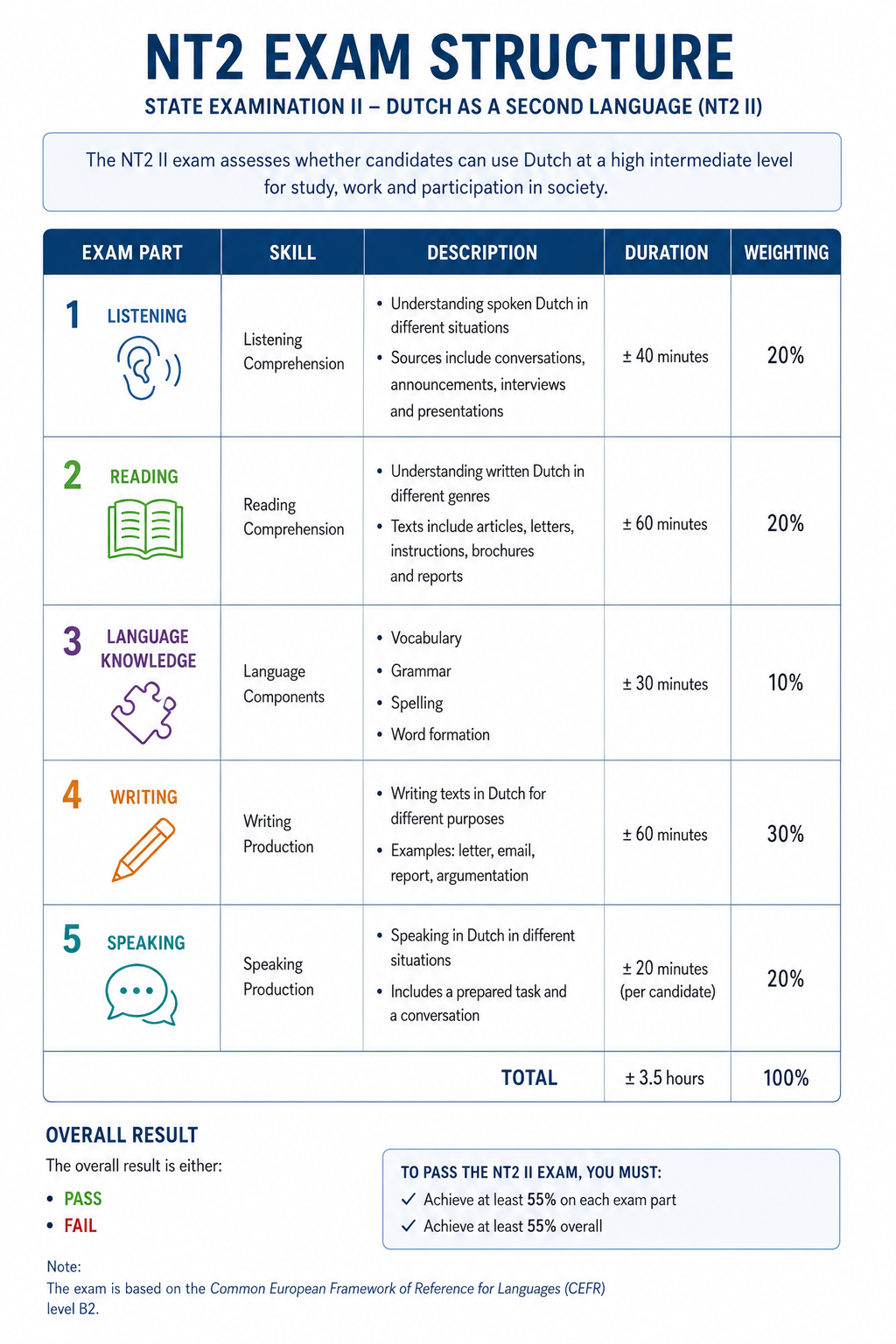
The NT2 exam is divided into two programmes aligned with the CEFR framework.
Programma I is aligned with CEFR level B1 and focuses on practical Dutch used in work and everyday life. It is commonly suitable for vocational environments and daily communication situations.
Programma II is aligned with CEFR level B2 and is designed for academic and professional contexts. This level is often required for HBO and university programmes, as well as many Dutch-speaking workplaces.
Choosing the correct programme is essential. Many candidates overestimate their productive skills, especially speaking and writing, which often creates difficulties during the exam itself.
NT2 exam dates and registration in 2026
The Staatsexamen NT2 takes place at official exam locations across the Netherlands. Candidates choose their preferred location and available exam dates during registration.
Registration periods vary throughout the year and are published through the official Staatsexamens NT2 platform.
Reading, listening, writing and speaking can all be scheduled separately. If a candidate fails one section, only that specific component must be retaken.
Official practice materials, exam schedules and registration information are available through Staatsexamens NT2 and DUO.
What to expect from Programma I (B1)
Programma I focuses on practical communication situations used in everyday life and work environments. Candidates are expected to understand routine information, manage common conversations and communicate clearly in familiar contexts.
The reading section includes practical texts such as advertisements, short articles, instructions and informational materials. Candidates must identify key details, scan efficiently and understand the main message.
The listening section focuses on workplace conversations, announcements and practical dialogues commonly encountered in daily life.
During the writing section, candidates complete forms, emails and short written messages. Examiners primarily evaluate clarity, structure and whether the task has been completed appropriately.
The speaking section evaluates pronunciation, fluency and the ability to respond effectively in realistic communication scenarios.
Common challenges at B1 level
Many candidates lose points because their writing lacks structure or fails to address all parts of the task. In speaking tasks, nervousness often leads to overly short answers or unclear communication.
In reading and listening sections, time management is a common issue. Strong candidates learn to recover quickly if they miss information instead of focusing too long on a single question.
What to expect from Programma II (B2)
Programma II is designed for learners preparing for higher education or professional Dutch-speaking environments. The language becomes more formal, abstract and argumentative.
The reading section includes editorials, reports, academic-style texts and opinion articles where candidates must understand nuance, tone and argumentation.
The listening section often contains lectures, interviews, debates and longer explanations involving multiple speakers or more complex topics.
In the writing section, candidates are expected to produce formal texts with clear structure, logical arguments and appropriate register.
The speaking section focuses on explaining viewpoints, comparing ideas and responding professionally in formal communication situations.
Common challenges at B2 level
Writing is often the most difficult component at B2 level. Candidates frequently struggle with cohesion, formal register and argument structure.
Speaking tasks become more demanding because answers must remain structured, precise and fluent under time pressure.
Listening and reading sections also require understanding implied meaning, nuance and abstract vocabulary rather than only factual information.
How the NT2 exam is graded
Each section of the exam is graded separately: reading, listening, writing and speaking.
To receive the diploma, candidates must pass all four components. If one section is failed, only that individual component needs to be retaken.
This system allows candidates to focus future preparation on weaker skills without repeating the entire exam process.
NT2 exam costs in 2026
The official exam cost is approximately €50 per component.
Candidates taking the full exam usually pay around €200 for all four sections combined.
How to prepare effectively for the NT2 exam
Successful preparation starts with a realistic study plan. Most adult learners preparing alongside work or studies benefit from several months of regular practice.
Consistent daily exposure is usually more effective than occasional intensive study sessions. Short study blocks focused on reading, listening, writing and speaking generally create more sustainable progress.
Using official NT2 materials is essential because the format differs from standard Dutch learning resources.
Training under timed conditions is also important. Many candidates have sufficient Dutch knowledge but struggle because they are not prepared for the time pressure of the exam itself.
Why blended learning works well for NT2 preparation
Many successful candidates combine independent self-study with structured teacher guidance.
Self-study improves reading speed, vocabulary and listening comprehension, while teacher feedback helps identify structural mistakes and improve communication strategies more efficiently.
Mock exams corrected by experienced teachers also help candidates understand scoring criteria and prepare more strategically.
Preparing for NT2 with coLanguage
Structured NT2 preparation combines guided self-study, speaking practice and targeted correction on the most challenging sections of the exam.
Feedback on writing, speaking and exam strategy helps candidates identify weaknesses more efficiently and prepare more consistently.
Flexible online lessons also make it easier for working professionals and busy learners to prepare regularly.
Final advice for NT2 candidates
Passing the NT2 exam is not about speaking perfect Dutch. The exam evaluates whether you can communicate effectively in realistic academic, professional and social situations.
Understanding the structure of the exam, preparing consistently and practicing under realistic conditions significantly improves your chances of success.
Starting early and preparing strategically allows you to approach the exam with more confidence and less stress on exam day.
Veel succes met je voorbereiding!
Why +10k learners have chosen already coLanguage?
| Feature | coLanguage | Informal tutoring | Learning apps |
|---|---|---|---|
Personalized tasks and hand-insYour teacher sets personalized tasks—and the app adapts exercises to your level and the areas you find hardest. |
|||
Learning portalStudy online or offline with PDF downloads, interactive exercises, audio, video, and AI-powered writing feedback. |
|||
Structured learning pathsFollow clear paths from A1 to C1, plus professional courses tailored to your goals. |
|||
Conversation classesEvery teacher is personally screened and trained to teach with our learning portal—so your classes match your course and progress. |
|||
Offline worksheets (PDF, translated)Download the full e-book as PDF, or print any lesson as a translated worksheet. |
|||
Quality guaranteeWe partner with universities and align every course with official learning programs—for reliable, recognized learning. |
|||
Learn with real content (news, podcasts…)Practice with real news articles and podcasts—immersive content that prepares you for everyday language. |
|||
Full-skill training: listening, reading, writing, speakingTrain all four skills: listening and pronunciation with audio, reading with authentic texts, writing with AI feedback, and speaking in your classes. |
|||
Course materials trusted by official libraries and bookshopsOur books are sold in bookshops across Belgium, the Netherlands, Spain, Portugal, France, Germany, Switzerland, Poland, Austria, and beyond—and approved by public libraries. |
|||
Academic collaboration with universitiesCourse plans are co-developed from our Valencian office with multiple European universities. |
Anja Radovanovican
Last Updated:
Wednesday, 13/05/2026 10:32
120+ professional teachers, ready to teach you!
You learn with a professional learning portal in combination with private classes with your teacher.




Our teachers studied at, among others...


What students say
- 4.6/5
Not flashy, just consistent. The course book and portal follow one line; that matters more than random exercises.
- 4.9/5
Preparing for an exam while working full time. Audio with translation makes revision realistic on short breaks.
- 4.7/5
I use the book on the train and the portal in the evening. English fits around my job without extra planning.
- 4.4/5