How to learn Italian

How to learn Italian: a practical guide to start and stay consistent
Learning Italian can open the door to travel, culture, work opportunities and meaningful communication. Many learners begin with motivation but lose direction because they study randomly, use too many resources or do not follow a clear plan.
Italian is an expressive and structured language. It is closely connected to art, food, music, cinema and everyday conversation. Whether you are learning for travel, career, education or personal interest, progress becomes easier when your learning is consistent and realistic.
Why learning Italian is worth it
Italian is spoken in Italy, parts of Switzerland, San Marino and Vatican City, as well as in Italian-speaking communities around the world. It is especially useful for learners interested in fashion, design, tourism, gastronomy, culture and international communication.
Learning Italian also makes travel more meaningful. Instead of depending only on tourist-level communication, you can speak with locals, understand signs and menus, and experience Italian culture more deeply.
It also gives you access to Italian films, books, songs and traditions in their original language, which makes learning more enjoyable and memorable.
Is Italian difficult to learn
Italian may look challenging at first, but many learners find it more approachable than expected. It belongs to the Romance language family, which means it shares vocabulary and grammar patterns with Spanish, French and Portuguese.
Italian pronunciation is also quite predictable. Words are usually pronounced as they are written, which makes reading aloud easier once you understand the basic sound system.
Some parts still require attention. Sounds such as gli in figlio, gn in gnocchi, double consonants such as in pizza or notte, and the rolled r can take practice.
Regional variation is another important part of Italian. Standard Italian is used in education, media and official communication, but vocabulary and expressions can differ across regions. For example, words connected to food, family and daily life may change from one area to another.
Build a structured learning plan
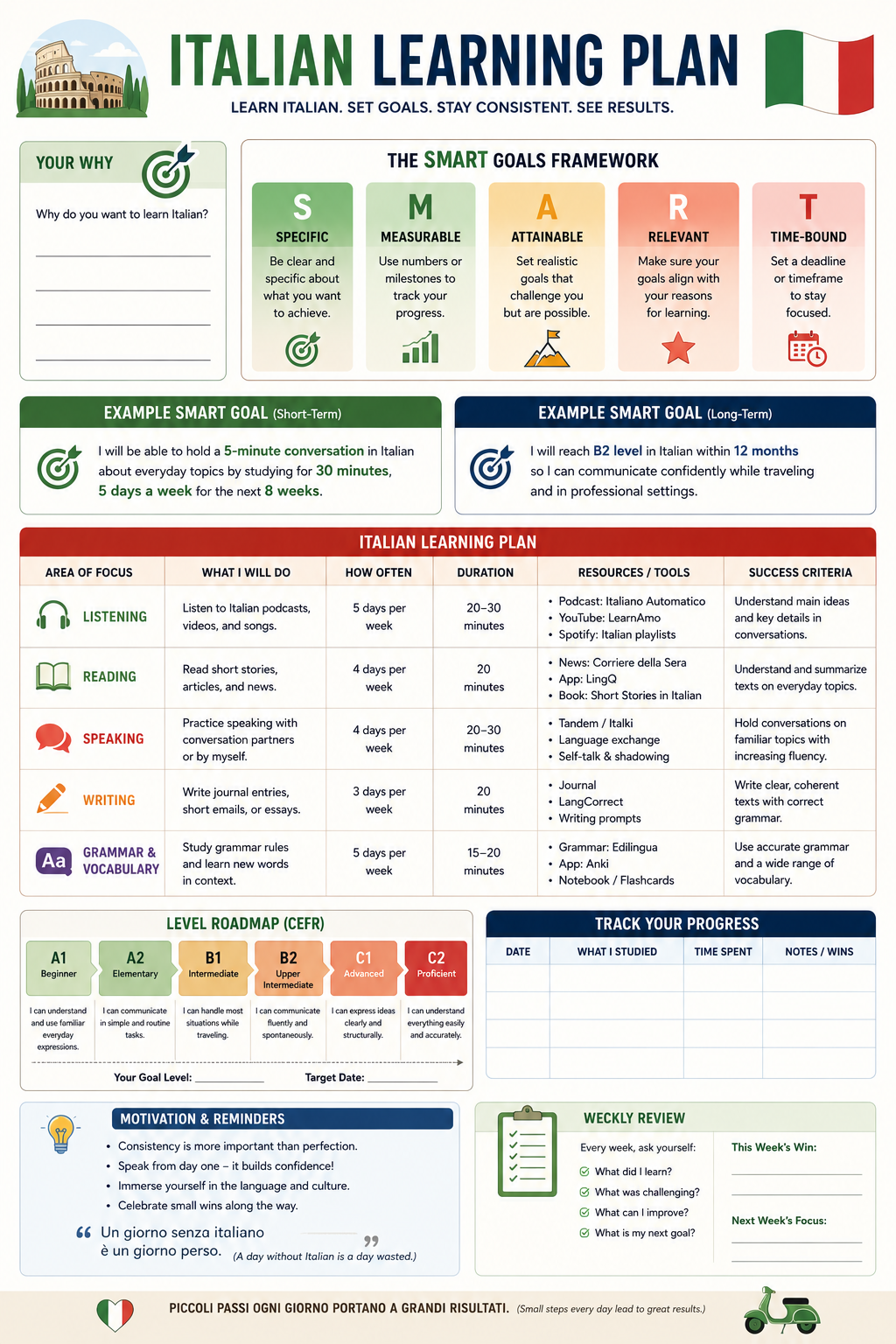
One of the most common mistakes in language learning is starting without a clear goal. Before choosing materials or lessons, define why you want to learn Italian. Your goal may be travel, work, study, family communication or cultural interest.
A clear goal helps you choose the right learning path and stay motivated. It is useful to combine short-term goals with long-term goals, so you can see progress without feeling overwhelmed.
A simple SMART goal structure can help:
- Specific: define exactly what you want to achieve
- Measurable: track your progress clearly
- Achievable: choose goals that fit your time and level
- Relevant: connect your goal to your personal reason for learning
- Time-bound: set a realistic deadline
This structure turns a vague goal such as “I want to learn Italian” into a practical plan that can be followed step by step.
Include Italian in your daily life
Regular exposure is one of the most effective ways to improve. The more often you see and hear Italian, the more natural the language becomes.
You can include Italian in your routine by changing your phone language, watching Italian films or series, listening to Italian podcasts, reading short texts or following Italian creators online.
Good starting points include Italian TV series such as Un Medico in Famiglia, Tutti Pazzi per Amore or The Young Pope. For films, learners often enjoy La Vita è Bella, Manuale d’amore or Viva la libertà.
For audio practice, podcasts such as Coffee Break Italian, Podcast Italiano and Learn Italian with Lucrezia can help you get used to natural speech. Italian music by artists such as Måneskin, Laura Pausini and Eros Ramazzotti can also make regular exposure more enjoyable.
Learn through culture and real-life context
Italian is closely connected to culture and daily life. Learning the language becomes more meaningful when you understand how it is used in real situations.
Culture helps you remember vocabulary and expressions because language is connected to habits, gestures, food, music and social interaction. Italian traditions such as Ferragosto, Natale and Carnevale can give useful context to the words and expressions you learn.
This cultural connection makes Italian feel less like a school subject and more like a living language.
Practice actively from the beginning
Understanding Italian is different from using it. Many learners spend a lot of time listening or reading, but delay speaking and writing because they are afraid of mistakes.
Active practice should start early. Speaking out loud, writing short texts and forming your own sentences help you build confidence and remember vocabulary more effectively.
Simple daily actions can make a difference:
- Repeat useful words and phrases out loud
- Write a few sentences about your day
- Name objects around you in Italian
- Describe what you are doing, even silently
These small exercises may seem simple, but repeated practice helps move knowledge into long-term memory.
Learn with structured guidance
Self-study can be useful, but many learners lose motivation when they do not know what to study next. A qualified teacher or structured course gives direction and helps you avoid wasting time.
A teacher can correct pronunciation, explain grammar clearly and adapt lessons to your level and goals. This feedback is especially important for speaking and writing, where mistakes are harder to notice alone.
Structured guidance also helps you keep a balanced learning routine, instead of focusing only on vocabulary or passive exercises.
Stay consistent and motivated
Consistency is one of the most important factors in language learning. Short, regular study sessions are usually more effective than long but irregular practice.
Even 15 to 20 minutes per day can help if you use that time well. Regular review strengthens memory, while small goals make progress easier to recognise.
Useful habits include reviewing vocabulary, writing short texts, practising simple conversations and celebrating small milestones. Understanding a sentence in a film or holding a short conversation are signs of real progress.
Italian language certificates
For learners who need formal recognition, Italian offers official language certificates. The most common are CILS and CELI.
CILS is issued by the Università per Stranieri di Siena, while CELI is issued by the Università per Stranieri di Perugia. Both are aligned with the CEFR framework, from A1 to C2, and can be useful for academic, professional or administrative purposes.
Certificates are especially relevant for learners who need proof of Italian level for study, work, citizenship or relocation.
Survival Italian for beginners
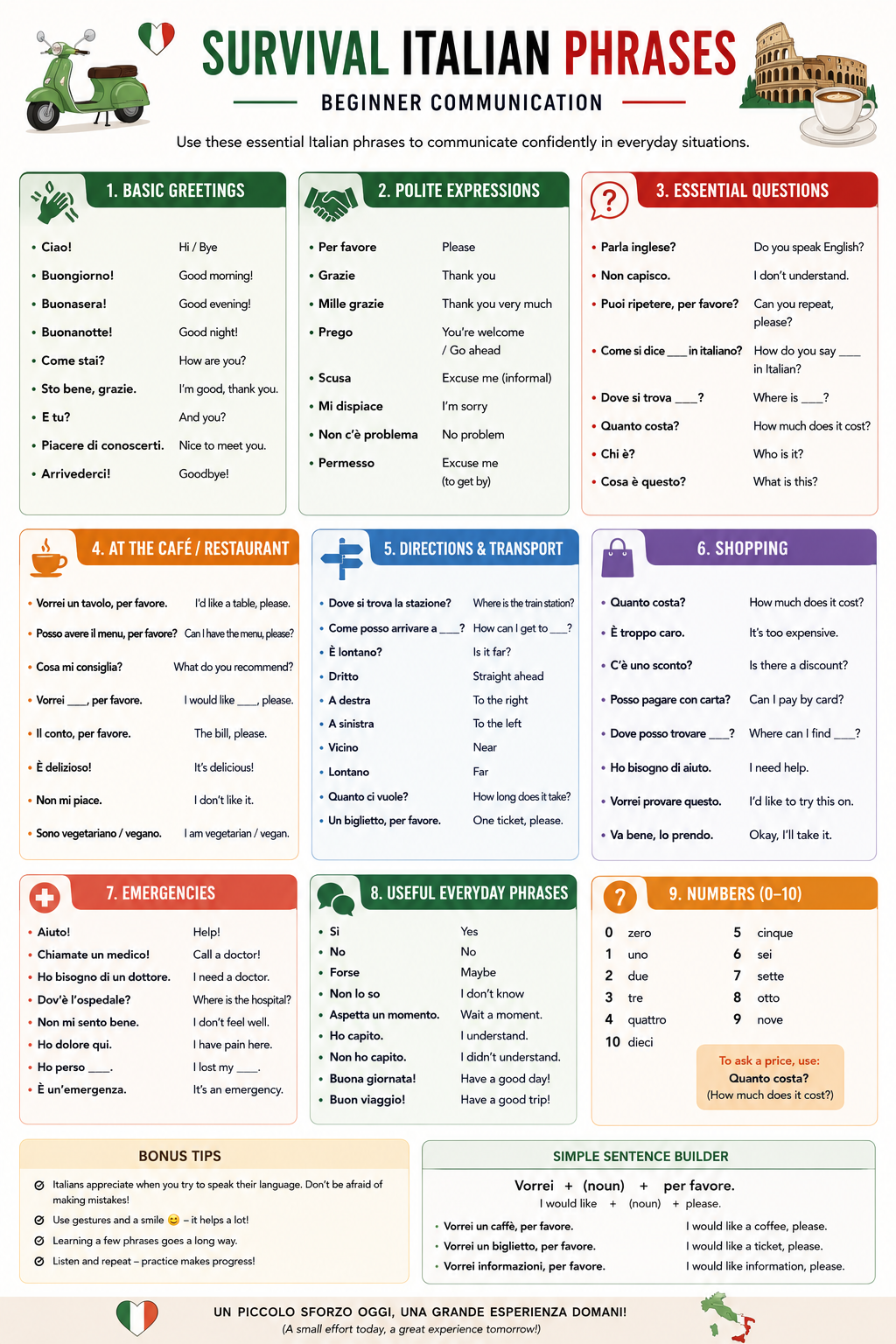
Before learning complex grammar, it is helpful to memorise basic phrases for everyday situations.
- Buongiorno – Good morning
- Buonasera – Good evening
- Ciao – Hello / Bye
- Per favore – Please
- Grazie mille – Thank you very much
- Scusi – Excuse me
- Quanto costa? – How much does it cost?
- Non capisco – I do not understand
- Può ripetere? – Can you repeat?
- Dove si trova la stazione? – Where is the station?
- Mi può aiutare? – Can you help me?
These expressions help beginners start communicating immediately and build confidence in real situations.
Final advice for learning Italian
Learning Italian is a long-term process, but it becomes much easier when you combine clear goals, daily exposure and active practice.
You do not need to be perfect before you start speaking. The most important step is to begin, stay consistent and use the language regularly.
With a structured plan, practical resources and regular feedback, Italian becomes more manageable, enjoyable and rewarding over time.
Learning method
Recommended course duration 12 weeks, about 15 minutes a day.
Self-study
Portal and ebook at your own pace, in office hours or free time.
From €1.50/month
- — Online exercises, digital portal, ebook and PDF downloads
-
- — Play lessons from the portal or the book QR
-
Listen with a parallel translation beside the audio.
- — Instant writing feedback while you practice
-
Personalized feedback on grammar and wording as you write.
Optional conversation classes
One class a week around your work, plus 30 minutes of self-study a day.
From €15/h
- Flexible class schedule
- Guidance of a teacher
- Stay motivated with live practice
- Recommended: 12 live classes
What students say
- 4.6/5
Not flashy, just consistent. The course book and portal follow one line; that matters more than random exercises.
- 4.9/5
Preparing for an exam while working full time. Audio with translation makes revision realistic on short breaks.
- 4.7/5
I use the book on the train and the portal in the evening. English fits around my job without extra planning.
- 4.4/5