Prepare for the Goethe-Zertifikat exam in 2026

How to prepare for the Goethe-Zertifikat exam in 2026
Preparing for the Goethe-Zertifikat exam requires more than general German knowledge. Many candidates study for months but still struggle because they are not familiar with the exam format, timing and expectations. The difference between passing and failing is often how well you understand the exam before you begin preparing.
The Goethe-Zertifikat is the official German language certificate issued by the Goethe-Institut on behalf of the German Federal Foreign Office. It certifies your level according to the CEFR (A1–C2) and is recognised worldwide by universities, employers and public authorities.
With examination centres in more than 90 countries, the Goethe-Institut sets the international standard for German language certification. A structured preparation approach helps you focus on the right skills and avoid common mistakes.
Why take the Goethe-Zertifikat
The Goethe certificate is often required for academic, professional and administrative purposes. It provides official proof of your German level and supports long-term goals.
- Improving career opportunities in German-speaking environments
- Meeting residency or citizenship requirements
- Accessing university programmes taught in German
Preparing for the exam also gives your learning a clear structure and measurable progress.
Understanding Goethe levels (A1–C2)
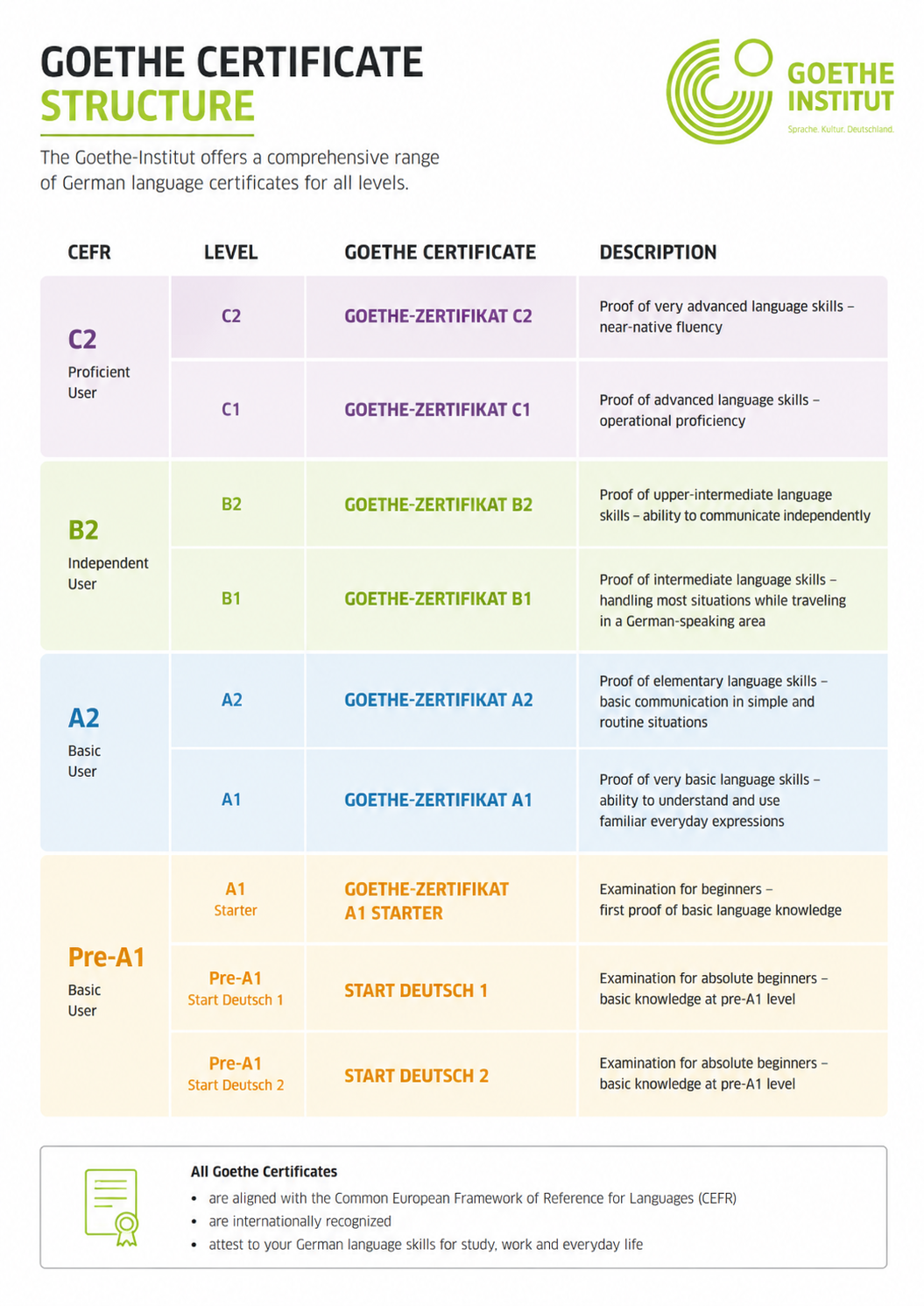
A1 level
At A1 level, candidates demonstrate basic communication skills needed for simple everyday situations. The exam focuses on understanding short written texts, basic listening exercises and simple interactions.
Reading tasks include short advertisements, emails, notices or forms. Listening tasks contain short dialogues, announcements and simple instructions spoken clearly and slowly.
In the writing section, candidates complete forms or write short personal messages. The speaking section focuses on introducing yourself, answering simple personal questions and handling basic communication situations.
A2 level
At A2 level, candidates are expected to communicate more independently in familiar situations. Reading tasks become slightly longer and often include practical texts related to travel, work or daily routines.
Listening tasks involve simple conversations, public announcements and everyday discussions. Writing usually includes short emails or descriptions, while speaking requires exchanging information and participating in simple conversations.
B1 level
At B1 level, candidates must communicate independently in common social and professional situations. Reading tasks may include articles, instructions, reports and opinion texts.
Listening tasks become more detailed and may include interviews, discussions or workplace conversations. Writing requires structured texts such as emails, letters or forum posts with clear organisation.
From B1 level onwards, the speaking exam is often conducted in pairs. Candidates are expected to interact with another participant, exchange opinions and complete communication tasks together.
B2 level
At B2 level, the exam focuses on confident and structured communication in academic, social and professional contexts. Reading tasks involve more complex texts where candidates must understand arguments, tone and implied meaning.
Listening sections may include interviews, presentations or debates with faster speech and more abstract topics. Writing tasks require clear argumentation and formal structure, while speaking focuses on presenting ideas, defending opinions and interacting fluently with another candidate.
C1 level
At C1 level, candidates must demonstrate advanced communication skills in complex contexts. Reading tasks include analytical texts, formal articles and academic-style materials.
Listening sections involve lectures, debates and detailed discussions with more nuanced language. Writing tasks require structured and well-argued texts with precise vocabulary and strong coherence.
In the speaking section, candidates must express complex ideas clearly, react spontaneously and participate actively in detailed discussions.
C2 level
At C2 level, candidates are expected to demonstrate near-native communication skills. Reading and listening tasks involve highly complex texts, abstract discussions and sophisticated vocabulary.
Writing tasks require stylistic precision, advanced argumentation and accurate control of register. The speaking section evaluates fluency, flexibility and the ability to communicate effectively in demanding formal situations.
At all levels, success depends not only on grammar and vocabulary, but also on organisation, time management and familiarity with the structure of the exam.
Choosing the right level
Selecting the correct level is essential. Many candidates overestimate their ability, especially in speaking and writing.
Before registering, consider:
- Your real ability to speak and write, not just grammar knowledge
- The time you can realistically dedicate to preparation
- Your goal (study, work or residency)
A full model test is the most reliable way to assess your level and understand exam expectations.
Goethe-Zertifikat exam fees
Fees vary depending on the country and examination centre. Indicative prices are approximately €155 for A1, €175 for A2, €259 for B1, €289 for B2, €349 for C1 and €359 for C2.
How to prepare effectively for the Goethe exam
Preparation should be based on a realistic study plan adapted to your level and timeframe. Most candidates require between three and six months of consistent preparation.
Shorter preparation periods are possible, but they require more intensive daily study and a strong focus on exam tasks.
An effective preparation strategy includes:
- Working with official Goethe model tests
- Practising under real exam conditions with time limits
- Developing all four skills in parallel
Speaking and writing should be prioritised early, as these are the most common reasons candidates lose points.
Improving speaking and writing
Speaking and writing require active practice and feedback. Many learners understand German well but struggle to produce structured responses.
To improve effectively:
- Practise real exam tasks regularly
- Use a timer to simulate exam conditions
- Get corrections from a qualified teacher
This helps you develop fluency, improve structure and reduce mistakes during the exam.
Why structured preparation improves results
Self-study is useful for building vocabulary and grammar, but structured preparation ensures that your work is aligned with official exam criteria.
Guided preparation helps you focus on the skills that matter most, avoid common mistakes and improve efficiency.
This combination of structured study, practice and feedback allows you to progress faster and approach the exam with confidence.
Final advice for Goethe candidates
Passing the Goethe-Zertifikat is not about perfect German, but about demonstrating your ability to communicate effectively within a structured format.
Understanding the exam, preparing consistently and focusing on key skills significantly increases your chances of success.
Starting early and following a clear preparation plan allows you to approach the exam with confidence and achieve a strong result.
Learning method
Recommended course duration 12 weeks, about 15 minutes a day.
Self-study
Portal and ebook at your own pace, in office hours or free time.
From €1.50/month
- — Online exercises, digital portal, ebook and PDF downloads
-
- — Play lessons from the portal or the book QR
-
Listen with a parallel translation beside the audio.
- — Instant writing feedback while you practice
-
Personalized feedback on grammar and wording as you write.
Optional conversation classes
One class a week around your work, plus 30 minutes of self-study a day.
From €18/h
- Flexible class schedule
- Guidance of a teacher
- Stay motivated with live practice
- Recommended: 12 live classes
What students say
- 4.6/5
Not flashy, just consistent. The course book and portal follow one line; that matters more than random exercises.
- 4.9/5
Preparing for an exam while working full time. Audio with translation makes revision realistic on short breaks.
- 4.7/5
I use the book on the train and the portal in the evening. English fits around my job without extra planning.
- 4.4/5