


This review is based on the opinion of coLanguage.
We are in any case ready to assist you if you decide to study with us!

How to prepare for the CILS exam in 2026
Preparing for the CILS exam requires more than general knowledge of Italian. Many candidates study consistently but still struggle during the exam because they are not familiar with the structure, timing and evaluation criteria. The difference between passing and failing is often how well you understand the exam before you begin preparing.
The CILS (Certificazione di Italiano come Lingua Straniera) is the official Italian language certificate issued by the Università per Stranieri di Siena and recognised by the Italian Ministry of Foreign Affairs. It is accepted for Italian citizenship, university admission, visas and professional purposes.
A structured preparation approach allows you to focus on the right skills, avoid common mistakes and perform more confidently under exam conditions.
Why take the CILS exam
The CILS certificate is widely used for academic, professional and administrative goals. It provides official proof of your Italian level and supports long-term plans such as relocation or career development.
- Meeting language requirements for Italian citizenship (B1 Cittadinanza)
- Accessing universities and academic programmes in Italy
- Demonstrating Italian language skills for work and relocation
For many learners, preparing for the exam also brings structure and clear milestones to their learning process.
Understanding CILS levels (A1–C2)
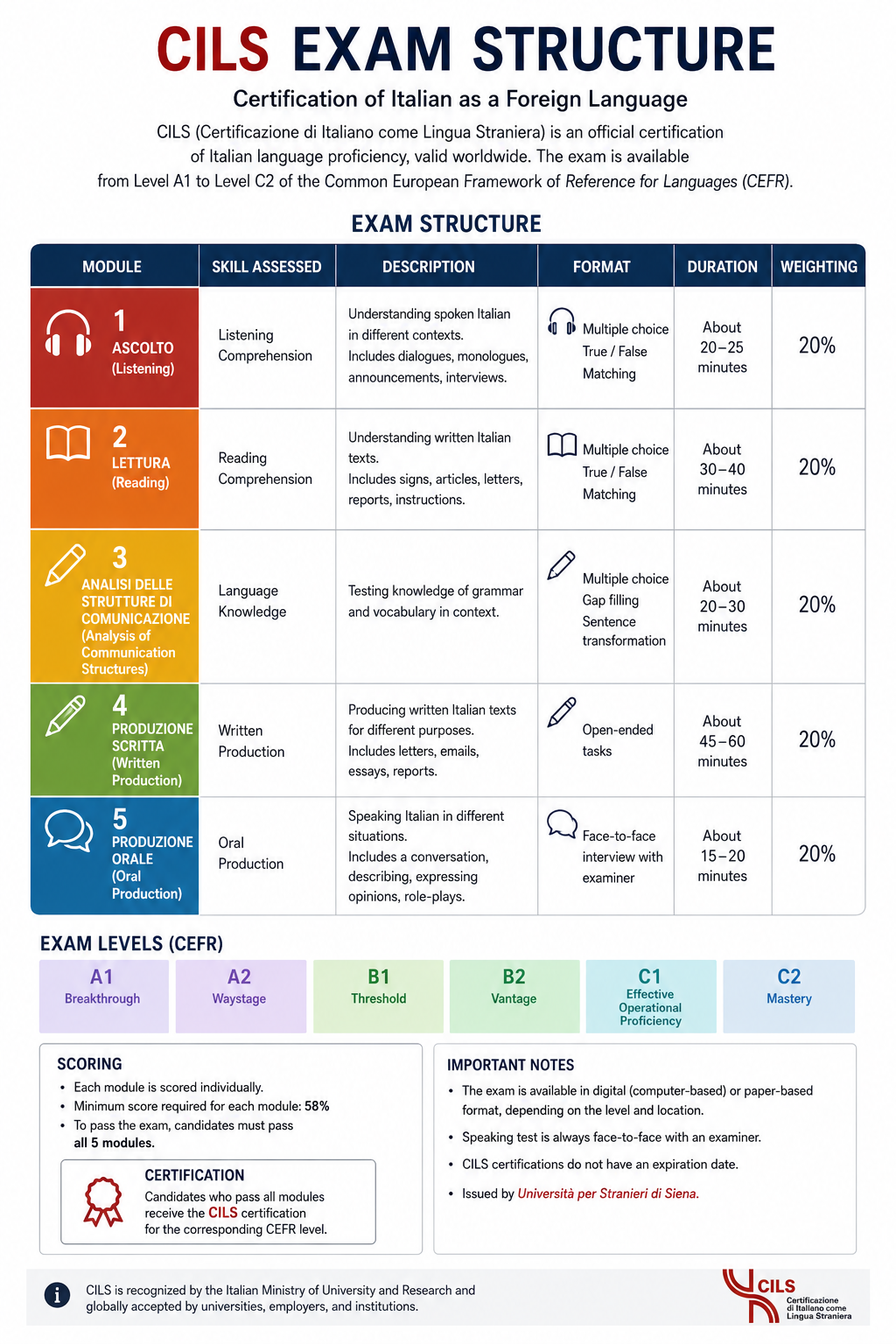
All CILS exams follow the CEFR framework and assess five skills: listening, reading, grammar and structures, writing, and speaking.
At A1 and A2 levels, the focus is on basic communication, such as understanding simple texts and handling everyday situations.
At B1 and B2 levels, candidates are expected to communicate independently, express opinions and manage real-life situations. The B1 Cittadinanza exam is specifically adapted to everyday and administrative contexts.
At C1 and C2 levels, the exam evaluates advanced communication, including structured arguments, complex texts and precise use of language in professional or academic environments.
Choosing the right level
Selecting the correct level is essential. Many candidates overestimate their ability, especially in writing and speaking.
Before registering, evaluate how clearly you can express ideas, not just how well you understand grammar. Also consider the time you can realistically dedicate to preparation and your final objective.
A full model exam is the most reliable way to assess your level and identify gaps early.
What the CILS exam looks like
The CILS exam consists of five parts: listening, reading, grammar and structures, writing and speaking. Each part is evaluated separately.
One key difference compared to other language exams is the dedicated grammar section, which requires specific preparation and accuracy.
Tasks are designed to reflect real communication situations, so clarity, organisation and relevance are as important as correctness.
CILS exam structure by level
A1 – Beginner level
At A1 level, the exam focuses on very basic communication and everyday situations. Reading tasks usually include signs, short messages, advertisements or simple forms. Listening exercises involve short dialogues spoken slowly and clearly.
Writing tasks require candidates to complete forms or write short personal messages using simple vocabulary and structures. In the speaking section, candidates introduce themselves, answer basic questions and participate in short everyday interactions.
A2 – Elementary level
At A2 level, tasks become slightly longer and require more independence. Candidates must understand simple emails, instructions and practical information related to daily life.
Listening exercises involve short conversations and announcements, while writing tasks include basic descriptions, short emails or personal texts. The speaking section focuses on describing familiar situations and maintaining simple conversations.
B1 – Intermediate level
At B1 level, candidates are expected to communicate more independently and express opinions clearly. Reading tasks include articles, public information and structured texts related to work, travel or daily life.
Writing tasks require organised responses with clear structure and coherent ideas. In speaking, candidates must describe experiences, explain opinions and interact actively during conversations.
B1 Cittadinanza
The B1 Cittadinanza exam is specifically designed for candidates applying for Italian citizenship. The focus is placed on practical communication used in administrative and everyday contexts.
Unlike standard CILS exams, all sections must be passed during the same exam session and partial retakes are not allowed.
B2 – Upper intermediate level
At B2 level, the exam evaluates more advanced communication skills and the ability to manage formal or semi-formal situations. Reading and listening tasks become longer and include interviews, reports and opinion texts.
Writing requires structured argumentation and correct register, while speaking tasks involve discussing opinions, defending viewpoints and interacting more naturally under time pressure.
C1 – Advanced level
At C1 level, candidates must understand complex texts and communicate effectively in academic or professional contexts. Reading tasks involve abstract or specialised topics, while listening includes fast and nuanced spoken language.
Writing tasks require well-structured arguments and precise language use. Speaking evaluates fluency, coherence and the ability to explain complex ideas clearly and confidently.
C2 – Proficiency level
At C2 level, candidates are expected to demonstrate near-native control of Italian. Tasks require advanced comprehension, precise vocabulary and stylistic flexibility.
The speaking and writing sections evaluate the ability to communicate naturally, structure arguments effectively and adapt language appropriately to different formal contexts.
Beyond language knowledge, time management and task organisation play a major role in exam performance across all levels.
CILS exam dates and registration
CILS exams are typically organised twice a year, in June and December. Registration deadlines usually close one to two months before the exam date, depending on the centre.
Planning ahead is important, especially for candidates taking the B1 Cittadinanza exam or applying for university programmes.
How to prepare effectively for the CILS exam
Effective preparation is based on consistency and structure. Most candidates need between three and six months of regular study.
A strong preparation strategy combines exam-specific practice with skill development:
- Working with official CILS model exams
- Practising under real exam timing
- Developing all five skills in parallel
Candidates who practise under realistic conditions perform significantly better than those who rely only on general language study.
Common mistakes to avoid
Many candidates lose points because of avoidable mistakes rather than lack of knowledge.
- Focusing too much on grammar and neglecting speaking and writing
- Not practising with real exam timing
- Choosing a level that is too high
- Ignoring the specific structure of CILS tasks
Being aware of these mistakes early can significantly improve your chances of passing.
Improving speaking and writing
Speaking and writing are the most challenging parts of the exam because they require active production and structured responses.
To improve effectively, you need regular practice and targeted feedback.
- Train with real exam tasks
- Use a timer to simulate exam conditions
- Get corrections from a qualified teacher
This helps you improve fluency, structure your ideas more clearly and reduce errors under pressure.
Why structured preparation improves results
Self-study helps build vocabulary and grammar, but structured preparation ensures that your work is aligned with official exam requirements.
A guided approach allows you to focus on the most relevant skills, avoid common errors and use your time more efficiently.
Combining structured study, practice and feedback gives you the best chance of passing the exam.
Final advice for CILS candidates
Passing the CILS exam is not about perfect Italian, but about demonstrating your ability to communicate clearly and effectively within a structured format.
Understanding the exam, preparing consistently and focusing on key skills will significantly improve your performance.
Starting early and following a clear plan allows you to approach the exam with confidence and achieve a strong result.
Why +10k learners have chosen already coLanguage?
| Feature | coLanguage | Informal tutoring | Learning apps |
|---|---|---|---|
Personalized tasks and hand-insYour teacher sets personalized tasks—and the app adapts exercises to your level and the areas you find hardest. |
|||
Learning portalStudy online or offline with PDF downloads, interactive exercises, audio, video, and AI-powered writing feedback. |
|||
Structured learning pathsFollow clear paths from A1 to C1, plus professional courses tailored to your goals. |
|||
Conversation classesEvery teacher is personally screened and trained to teach with our learning portal—so your classes match your course and progress. |
|||
Offline worksheets (PDF, translated)Download the full e-book as PDF, or print any lesson as a translated worksheet. |
|||
Quality guaranteeWe partner with universities and align every course with official learning programs—for reliable, recognized learning. |
|||
Learn with real content (news, podcasts…)Practice with real news articles and podcasts—immersive content that prepares you for everyday language. |
|||
Full-skill training: listening, reading, writing, speakingTrain all four skills: listening and pronunciation with audio, reading with authentic texts, writing with AI feedback, and speaking in your classes. |
|||
Course materials trusted by official libraries and bookshopsOur books are sold in bookshops across Belgium, the Netherlands, Spain, Portugal, France, Germany, Switzerland, Poland, Austria, and beyond—and approved by public libraries. |
|||
Academic collaboration with universitiesCourse plans are co-developed from our Valencian office with multiple European universities. |
Anja Radovanovican
Last Updated:
Wednesday, 13/05/2026 10:37
120+ professional teachers, ready to teach you!
You learn with a professional learning portal in combination with private classes with your teacher.





Our teachers studied at, among others...


What students say
- 4.6/5
Not flashy, just consistent. The course book and portal follow one line; that matters more than random exercises.
- 4.9/5
Preparing for an exam while working full time. Audio with translation makes revision realistic on short breaks.
- 4.7/5
I use the book on the train and the portal in the evening. English fits around my job without extra planning.
- 4.4/5